Planning an executive offsite for 20 people takes more than finding a venue with a nice view and booking lunch. The best offsites give leadership teams time away from daily demands to address the issues that are difficult to solve in the middle of a normal workday.
That might mean getting aligned around a new strategy, improving communication between departments, addressing friction within the leadership team, or preparing the organization to navigate significant change.
If you are planning an executive offsite near Austin, Texas, the first decision is not where to go. It is what needs to be different when your team returns to work.
This guide covers how to choose the right location, structure the day, compare program options, and plan an offsite that produces more than a collection of meeting notes.
1. Start With the Business Problem You Need to Solve
Before researching venues, identify the reason your leadership team needs to get away from the office.
A team that needs to develop a strategic plan requires a different experience from a team that struggles with trust, delegation, or cross-functional collaboration.
Common reasons to plan an executive offsite include:
- Strategic alignment: Your leaders have different interpretations of the company’s priorities or disagree about what matters most.
- Leadership team effectiveness: Departments operate in silos, handoffs are inconsistent, or decisions get stuck with the CEO.
- Navigating change: Your organization is growing, restructuring, integrating teams, or responding to an uncertain market.
- Trust and communication: Leaders avoid difficult conversations or struggle to challenge one another constructively.
- Leadership development: You want executives to understand their own leadership behaviors and how those behaviors affect the people around them.
Be specific about the outcome. Instead of saying, “We need better teamwork,” try, “We need our leaders to resolve disagreements directly and make decisions without escalating every issue to the CEO.”
That clarity will help you choose the right facilitator, activities, and schedule.
2. Choose the Right Type of Executive Offsite
Austin and the surrounding Texas Hill Country offer several types of executive offsite experiences. The right choice depends on what your team needs to accomplish.
Traditional meeting or conference venue
A conference room or private meeting space works well for strategic planning, financial reviews, presentations, and structured decision-making.
Look for reliable technology, comfortable seating, privacy, good food, and enough room for smaller breakout discussions.
This format is particularly useful when the agenda is primarily analytical and the team needs to work through detailed business decisions.
Luxury retreat or resort
A resort or retreat property can help executives step away from their regular routines. These locations may offer private meeting spaces, dining, accommodations, and wellness amenities.
They can be a good fit for multi-day strategy sessions or leadership retreats that combine focused work with time to recharge.
Before booking, confirm that the property can accommodate your actual meeting needs. A beautiful setting does not automatically provide a suitable space for confidential conversations or productive working sessions.
Outdoor experiential leadership development
Sometimes a leadership team needs more than a different place to hold the same meeting.
Experiential leadership development gives participants opportunities to observe how they communicate, make decisions, respond to uncertainty, and work together through shared challenges.
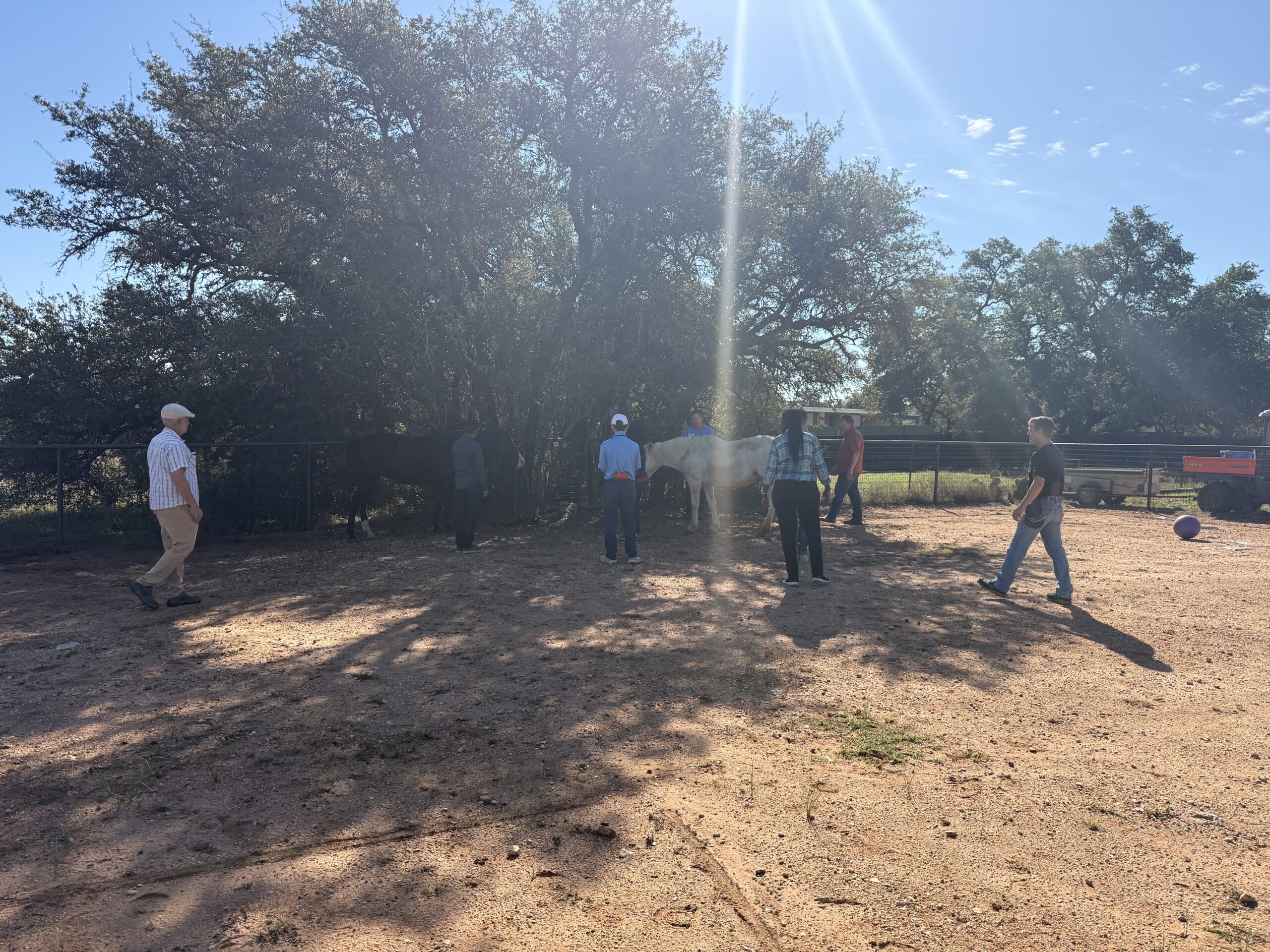
At Horse + Bow, in the Texas Hill Country near Marble Falls, teams work with horses through facilitated, ground-based experiences. The horses respond to human behavior and nonverbal communication, creating opportunities for leaders to examine their own approaches to influence, awareness, boundaries, and collaboration.
The experience is followed by facilitated reflection that connects what participants observe to their actual work.
This format can be especially useful when a team needs to improve trust, communication, delegation, or its ability to navigate change.
A hybrid offsite
For many executive teams, a combination of structured business discussions and experiential learning offers the most useful balance.
For example, a team might spend the morning examining its biggest leadership challenges, participate in a facilitated experiential exercise, and then use the afternoon to identify specific commitments for the workplace.
The key is to connect the experience to the business problem rather than treating it as an unrelated activity.
3. Find a Location That Works for 20 Executives
A group of about 20 is large enough that logistics matter, but small enough for meaningful discussion and individual participation.
When evaluating an executive offsite near Austin, consider the following.
Travel time and accessibility
Decide how far your team is willing to travel. Downtown Austin may be convenient for employees working in the city, while a location in the Hill Country can provide a more distinct break from the office.
Horse + Bow is located near Marble Falls, west of Austin. Allow for the actual drive from your team’s starting point when planning the schedule, and confirm directions and arrival logistics with your venue.
Space and facilities
Ask whether the venue can accommodate 20 people comfortably for the entire program. If you are considering an outdoor experience, clarify what happens in bad weather, what facilities are available, and whether there is an indoor space for discussion.
Privacy
Executive teams may need to discuss personnel decisions, organizational challenges, or confidential business plans. Choose a setting where private conversations are possible.
Food and dietary requirements
Confirm catering arrangements, meal timing, dietary accommodations, beverages, and any restrictions on outside food.
Accessibility and participation
Ask about walking distances, seating, rest areas, physical requirements, and alternative ways to participate. This is particularly important for outdoor and experiential programs.
The right atmosphere
Consider whether your team needs a polished corporate environment, a peaceful retreat setting, or an outdoor experience that challenges familiar routines.
The venue should support the work you want to accomplish.
4. Build an Agenda That Balances Business and Experience
A full-day executive offsite should have a clear beginning, middle, and end. Avoid filling every minute with presentations, but do not leave the day so open-ended that the team finishes without decisions.
Here is one example of how to structure a day for 20 leaders.
Sample full-day executive offsite agenda
| Time | Session | Purpose |
|---|---|---|
| 9:00–9:30 a.m. | Arrival and opening | Establish the objectives and define what success looks like |
| 9:30–10:30 a.m. | Leadership priorities | Identify the most important challenges facing the team |
| 10:30–10:45 a.m. | Break | Reset before the next session |
| 10:45 a.m.–12:00 p.m. | Facilitated experiential learning | Observe leadership behavior, communication, and team dynamics in action |
| 12:00–1:00 p.m. | Lunch | Build informal connection and allow time to recharge |
| 1:00–2:15 p.m. | Debrief and application | Connect observations to real workplace situations |
| 2:15–2:30 p.m. | Break | Allow time to reset |
| 2:30–3:30 p.m. | Commitments and decisions | Identify changes in behavior, ownership, and team practices |
| 3:30–4:00 p.m. | Closing and next steps | Confirm responsibilities and follow-up actions |
This is an illustrative agenda, not a fixed program. A strategy-focused offsite may require more working time, while a leadership development day may devote a larger portion of the schedule to experiential exercises and facilitated reflection.
The important thing is to protect time for application. If participants leave with interesting observations but no decisions about what they will do differently, the offsite has not finished its job.
5. What Does an Executive Offsite Near Austin Cost?
The cost depends on the venue, duration, catering, facilitation, travel, and whether you are booking a meeting space or a complete leadership development experience.
For a team of 20, ask providers for an itemized proposal so you can compare equivalent services.
The following are planning categories, not verified market averages or quotes from specific Austin venues.
| Expense | What to clarify |
|---|---|
| Venue | Room rental, outdoor space, setup, and cleanup |
| Facilitation | Preparation, program delivery, and follow-up |
| Catering | Lunch, beverages, snacks, and dietary accommodations |
| Activities | Materials, equipment, and specialist facilitators |
| Travel | Transportation, parking, and any overnight accommodation |
| Follow-up | Written summary, coaching, or implementation sessions |
For example, if a venue charges a flat rental fee, that cost may be separate from catering and facilitation. A facilitated leadership development program may instead bundle some or all of those services.
Horse + Bow offers facilitated horse-based leadership experiences in the Texas Hill Country. Pricing depends on the format, duration, group size, and program requirements. Contact the team for a current proposal for your group.
When comparing proposals, look beyond the total. Ask what preparation is included, who facilitates the experience, how the program is tailored to your objectives, and what participants will leave with.
6. Questions to Ask Before Booking a Facilitator
The quality of facilitation can matter as much as the venue itself.
Before committing, ask prospective providers:
How do you tailor the experience to our leadership challenges?
A strong facilitator should want to understand your team’s goals before recommending an agenda.
What will participants actually do?
Ask for a clear description of the activities, their purpose, and how they connect to leadership behavior.
How do you turn the experience into workplace learning?
Activities alone do not guarantee learning. Look for structured debriefing, practical application, and specific next steps.
How do you accommodate different personalities and physical abilities?
Make sure participants can engage appropriately, including those who are uncomfortable with certain activities or have accessibility needs.
What is your experience facilitating executive teams?
Ask about relevant training, experience, group size, safety practices, and examples of the types of challenges you help teams address.
How do you evaluate success?
The answer should go beyond whether participants enjoyed the day. Ask how the program connects to the objectives you established at the outset.
7. How Horse-Assisted Leadership Development Fits Into an Executive Offsite
Working with horses is a different kind of leadership development experience.
Horses are sensitive to changes in movement, attention, and body language. In carefully facilitated, ground-based exercises, these responses can give participants an opportunity to notice how their behavior influences a shared task.
For example, leaders may explore questions such as:
- How clearly do I communicate my intentions?
- Do I pay attention to what others are communicating, or do I focus primarily on getting the task done?
- What happens when I try to control every part of a situation?
- How do I respond when my usual approach does not work?
- When do I step forward, and when do I allow someone else to lead?
These are not abstract questions when participants can reflect on a shared experience they have just completed.
At Horse + Bow, the facilitator helps connect those observations to workplace situations involving delegation, decision-making, communication, and team dynamics.
The purpose is not to teach people to control horses. It is to use the experience as a starting point for examining leadership behavior and considering what needs to change at work.
No riding experience is required for ground-based exercises. Before booking, discuss the program’s physical requirements and safety arrangements with the facilitator.
8. Make Sure the Offsite Leads to Change
The final hour of your offsite should not be an afterthought.
Before the team leaves, identify a small number of specific commitments. These might include:
- Establishing clearer ownership for cross-functional decisions.
- Agreeing on how disagreements will be addressed.
- Identifying decisions that no longer need to be escalated to the CEO.
- Improving handoffs between departments.
- Creating a regular process for discussing team friction before it becomes a larger problem.
Assign an owner to each commitment and schedule a follow-up conversation.
Two to four weeks later, ask the team what has changed, what has been difficult to implement, and where additional support is needed.
A successful offsite is not simply a day that people remember positively. It is a day that helps the team work differently afterward.
Plan Your Executive Offsite Near Austin
If you are organizing an offsite for approximately 20 executives, start by identifying the business challenge you need to address. Then choose a venue and facilitator who can help your team make meaningful progress on that challenge.
If your team needs to improve communication, strengthen trust, develop better delegation habits, or learn to navigate uncertainty together, Horse + Bow offers facilitated, ground-based horse experiences in the Texas Hill Country near Marble Falls.
The experience combines practical leadership challenges with guided reflection, helping leaders examine their behavior and connect what they learn to the realities of work.
Planning a leadership offsite for your executive team? Contact Horse + Bow to discuss your group’s objectives, preferred timing, and program options.
Visit Horse + Bow to learn more or inquire about a corporate leadership development experience.